Market Opportunities for Flutter Developers
Market Opportunities for Flutter Developers
Flutter's high performance and low barrier to entry have led developers and businesses worldwide to embrace the framework.
So who is developing Flutter applications, in what industries, and for what purposes? And how does the growth of Flutter compare to the competition, and even to native app development? Flutter is being used in some innovative and exciting ways — this page walks through them.
Chapter overview
Structure
- The growth of Flutter in the marketplace
- Who is using Flutter, and what are they using it for?
Objectives
The growth of Flutter in the marketplace
Since the first stable release of Flutter in December 2018, it has experienced steady growth in popularity and adoption worldwide. To put this in context, we need to compare it with the popularity of writing native applications for both iOS and Android, as well as with Flutter's top competitor: React Native.
The first one is Google Trends data. Google allows some interesting data to be pulled from their collected search results; for example, we can compare the popularity of search terms in any given period. The question is: how popular was the search term Flutter in comparison to its rivals on Google?
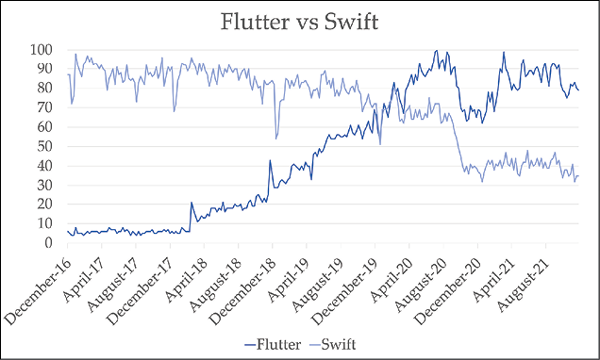
Figure 2.1: Popularity of “Flutter” vs “Swift” searches on Google, worldwide. (Source: Google Trends)
As expected, Flutter has grown at a steady rate since its first stable release. Swift searches remained relatively stable right until something interesting happened in December 2019. This was when Flutter 1.12 was released, with a beta release of web support and an alpha release of macOS support (Flutter, 2019), signaling to developers and companies that Flutter was here to stay.
There was another dip in August 2020, which you will see repeated in all data sources. This is due to the global lockdowns during the COVID-19 pandemic. Interestingly, Swift, the programming language for developing native iOS applications, never quite recovers from this dip in popularity, whereas Flutter sees an immediate jump back up to its former popularity, where it has continued to hover.
Kotlin is the primary programming language for developing Android applications natively (figure 2.2):
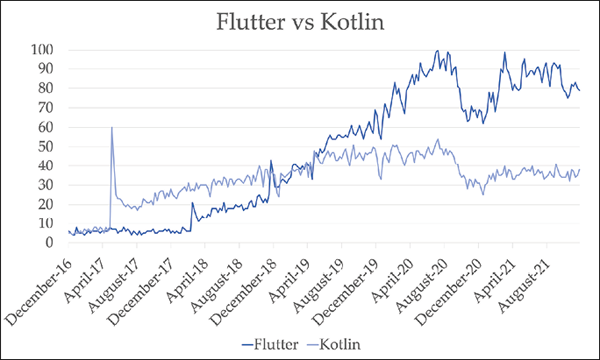
Figure 2.2: Popularity of “Flutter” vs “Kotlin” searches on Google, worldwide. (Source: Google Trends)
We see some of the same trends with Kotlin that we do with Swift: a dip during the lockdowns and its popularity never quite recovering. However, the data uncovers something else.
- During Google's I/O 2017 conference, it was announced that there would now be official support for the Kotlin programming language when writing Android apps, which explains the large spike in popularity in the graph data.
- Two years later, at I/O 2019, when Google announced that Android development would skew toward a Kotlin-first approach, the data shows that there were no more and no fewer searches for Kotlin.
Interestingly, we can derive from this data that either all (or most) developers who were writing native Android apps were already using Kotlin, or some other market interruption was already taking place.
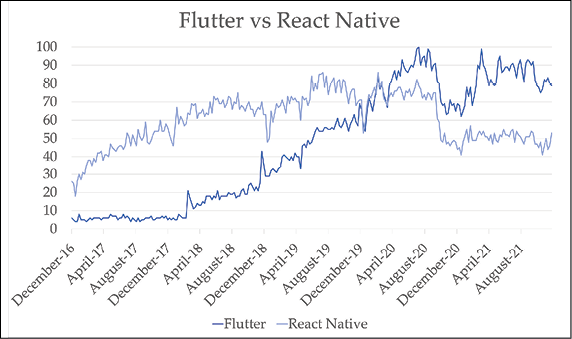
Figure 2.3: Popularity of “Flutter” vs “React Native” searches on Google, worldwide. (Source: Google Trends)
As with both Swift and Kotlin, we see some of the same trends emerge. Of course, there's the tell-tale pandemic slump in late 2020. There is also the lack of recovery following that slump.
What is clear from the start is that React Native enjoyed a much stronger overall growth when compared to both Kotlin and Swift. React Native's relatively late introduction to the game, when compared to Swift, would account for its seemingly lower popularity early on, as developers were already working with Swift as React Native matured. Kotlin, coming even later to the game, never quite saw the same popularity as React Native.
However, Flutter overtakes React Native quite quickly. Again, we see the trends leaning toward Flutter after Flutter's 2.0 release.
Comparing all these data points at once gives additional context (figure 2.4):
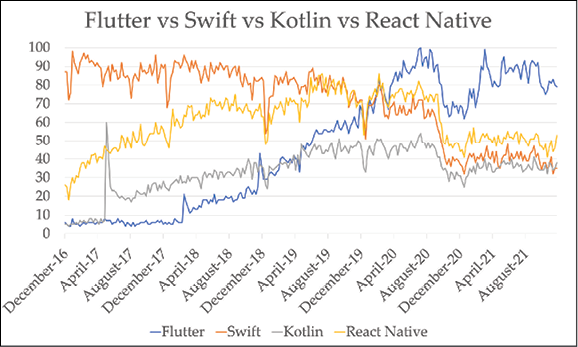
Figure 2.4: Popularity of “Flutter” vs the competition searches on Google, worldwide. (Source: Google Trends)
Flutter completely overtook the competition early in 2020, a few months after web support reached beta in Flutter 1.12 (December 2019).
For the first time in history, there was now a toolkit that would allow developers to create beautiful, performant applications for any platform with a single codebase — and the market took notice. The demand for Flutter developers during this time skyrocketed. Even those who spoke in hushed tones and suggested that they knew Flutter were being approached for work.
Now that we can quantify the popularity of Flutter versus the competition, we are left with another question.
Who is using Flutter, and what are they using it for?
Flutter is extremely versatile. It can target iOS, Android, macOS, Windows, Linux, and the Web, all with a single codebase. Additionally, it can be embedded in existing applications and can run on any platform with the use of a custom embedder.
There are many big names using Flutter, and many more are being added to that list on a regular basis. It should come as no surprise that Google is using Flutter for several of their big applications. Also, on the list of big players, we can find the likes of Alibaba, BMW, ByteDance, eBay, Toyota, Google, and many more.
Case study: Alibaba
Alibaba may not be a household name in America yet, but that does not mean they are not massive. The Wallstreet Journal helps to summarize Alibaba in one sentence: It is a marketplace, a search engine, and a bank, all in one (Wallstreet Journal, 2014). Suffice it to say the Alibaba Group is massive in China.
One of Alibaba's biggest apps is Xianyu, a second-hand marketplace, much like eBay is in the West.
Problem — two codebases
Problem — an existing app
Without being required to rewrite their entire application from scratch while still having the power and flexibility of incorporating Flutter widgets, the team was able to start shipping new features in half the time. That is the power of Flutter:

Figure 2.5: Screenshots of pages written in Flutter within the Xianyu application. (Source: (Kermittfx, 2021))
Case study: BMW
As BMW's mobile app offerings grew across all their brands, they faced a common problem: the features and design languages present in each of the applications, including the same application on multiple platforms, began to diverge and have more and more discrepancies. The fragmentation broke down the cohesiveness of the experience for users, which was unacceptable to the team.
BMW spent a long time evaluating multi-platform solutions. At first, they were skeptical that Flutter was mature enough to handle their needs, as this evaluation period was during the latter months of 2019, still relatively early in Flutter's releases. They built several proof-of-concept applications using each of Flutter and its competitors. In the end, it was Flutter that the team decided on when they chose to forego Web-based content in lieu of a better user experience.
Once the decision was made, BMW began to rewrite all its applications from scratch. They operate in more than 45 countries, all of which have different rules, regulations, and requirements, and their suite of applications would need to conform to all these regulations for each country they deploy in. To accomplish this, the team established a new internal platform, which they dubbed the Mobile 2.0 Platform.
The new app platform is built on three pillars: user friendliness, safety, and reliability. It provides a consistently designed set of functions spanning all brands based on feedback and our customers' usage behavior.
— Dr. Nicolai Kraemer, Vice President Offboard Platform BMW Group
The new Mobile 2.0 Platform allowed them to automate their application builds. Each application would need a new build for the market it serves and the operating system it would run on. Those builds would need to run automated tests and eventually be deployed.
Case study: ByteDance
ByteDance may not be a household name, but its biggest products sure are. ByteDance's most popular offering, TikTok (known in China as Dǒuyīn — albeit with a totally separate and separated content offering), is one of more than 70 applications in the company's portfolio. With more than 200 developers working with the toolkit, ByteDance is no stranger to Flutter development.
Their affinity for Flutter has benefitted the community at large, too. ByteDance has made major contributions to Flutter by submitting dozens of pull requests (Zakhour, 2021):
- Crucial debugging tools, such as the frames and timeline events charts, both used to help profile a Flutter application and identify potential slowdowns and resource usage.
- Help driving the core performance of Flutter by optimizing the framework.
ByteDance tends to embrace new technologies with the attitude that every mature technology was once new. As they have so eloquently put it:
There are indeed many people in the industry who prefer mature technology, but it takes time for every technology to mature, and there will always be people like us who love to stay on the cutting edge (Zakhour, 2021).
Xigua Video is ByteDance's video-sharing platform, offering both longform and short-form videos, and it even has its own film and television content. With more than 131 million monthly active users, it is a shining example of one of their products written with Flutter. Xigua Video is available on iOS, Android, and the Web, all from a unified codebase, thanks to the power and flexibility of Flutter.
Case study: eBay
As the first-ever online auction site, eBay is a company that needs no introduction. What some may not know is that eBay sells more than just trinkets: their business extends into the automotive space, as well. eBay recognized that its main application was not the right place to direct users for their automotive sales, so in 2018 the eBay Motors team was tasked with creating a mobile application within the year for both iOS and Android.
Recognizing the monumental task ahead of them, the small team knew they would need to leverage a cross-platform framework to accomplish their goal. Within a couple of short months, the team realized their choice to leverage Flutter was an extraordinarily good idea. They decided to evangelize Flutter within the company, organizing several workshops to bring the rest of the engineering team up to speed.
Flutter has not only met our expectations — it has dramatically exceeded them.
— Corey Sprague, Senior iOS Engineer, eBay
The larger engineering team at eBay was as impressed as the eBay Motors team with Flutter. With the groundwork already laid by the Motors team, the larger engineering team found it very easy to share code for the UI, the business logic, and all other parts of the application. According to the eBay Motors team, the amount of code shared is evident in the amount of Dart code in their repository (Sprague & McKenzie, 2020):
98.3%
1.1%
0.6%
Migrating to Flutter allowed all of eBay to coalesce into one team from many, giving everybody on the team equal footing and providing a more consistent experience for both users and engineers (figure 2.6):
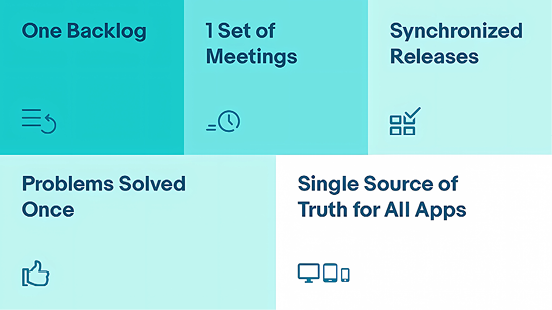
Figure 2.6: eBay has found using Flutter reduces the amount of work for engineers. (Source: tech.ebay.com)
Case study: Toyota
Producing about 10 million vehicles per year, Toyota is one of the world's largest automotive manufacturers. As those vehicles become more and more technologically advanced, so too do the instrument panels and infotainment centers.
Toyota is no stranger to these types of in-dash experiences. Having historically built their on-screen infotainment systems in-house, Toyota marveled at the speed and flexibility of Flutter. When they discovered Flutter was able to target embedded devices, they reached out to the Flutter team to establish a partnership. Through this partnership, Toyota began work on its next generation of in-dash experiences.
Daniel Hall, Toyota's Chief Engineer, recognized that non-smartphone touch interfaces are often frustratingly non-responsive. He and his team sought to remedy this by leveraging Flutter's first-class, smartphone-tier touch mechanics in their new (as of 2022) in-car experiences (figure 2.7):

Figure 2.7: Toyota’s new in-dash experience. Source: Carscoops (Carscoops, 2021)
Another way Toyota finds Flutter particularly well suited for development is the breadth of platforms that can be targeted using a single codebase. Developing and testing code directly on an instrument panel or infotainment system is cumbersome and comes with significant challenges, such as cost and a sacrifice in developer mobility. (Try lugging an instrument panel with you to a coffee shop!)
Desktop
iOS and Android
Web
The only reason all of this is possible is the flexibility of Flutter.
Case study: Google
Finally, we come to Google itself. It comes as no surprise that Google would use the toolkit that they have spent so long building within their own suite of applications and projects.
Their first application to be rewritten from the ground up in Flutter was Google Pay, their flagship mobile payments application. Immediately, users were treated to a faster, higher quality application when compared to the aging offering which it replaced. The shift to Flutter also streamlined their codebase, eliminating over 500k lines of code! Since then, Google has moved many of its applications over to Flutter (figure 2.8):
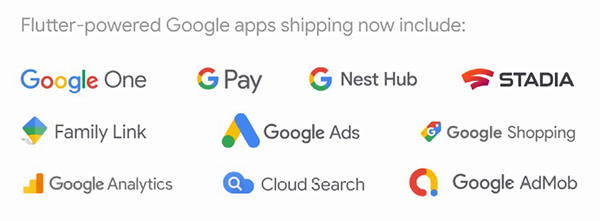
Figure 2.8: A selection of Google apps written in Flutter. Source: Google (Google, 2021)
Google also developed Stadia, their cloud streaming service for games, with Flutter. The Stadia app ran on both iOS and Android, sharing a single codebase. Because Stadia had its own custom game controller, the team needed to build a custom Bluetooth plugin using platform-native code. Once this plugin was embedded in their Flutter application, the process of communicating with the controller became seamless and transparent. The entire codebase weighed in at around half a million lines: far less than separate native applications would have required. Furthermore, the time they saved by using Flutter gave the team the opportunity to test and tweak the application for better performance and reliability before launch.
Bugs that would be a near-constant drag on productivity with two or more native clients, especially in a complicated flow, are practically a non-issue when using Flutter.
— Nick Sparks, Software Engineer, Stadia
Conclusion
As Flutter continues to mature, developers and companies alike have taken notice. Some of the biggest names in tech embraced Flutter, recognizing it for its game-changing ability to:
Speed up development
Lower costs
Feature parity
One team
From iOS to Android, the desktop, Web, Fuchsia, and even embedded in the dashboards of Toyota vehicles, Flutter keeps popping up in some of the most exciting places. The tireless efforts of companies like ByteDance, who contribute freely to Flutter, will certainly help to attract new developers and companies to the ecosystem!
Before moving on to setting up the developer environment, meet somebody very special: say hello to Dash, Flutter's very own hummingbird mascot (figure 2.9)!
Figure 2.9: Flutter’s mascot, Dash. (Source: docs.flutter.dev/dash)
References
- Carscoops. (2021, September 19). We Check Out The All-New Infotainment System In The 2022 Toyota Tundra. Retrieved from YouTube: https://www.youtube.com/watch?v=pFNYtLLhjrk
- Flutter. (2019, December 11). Announcing Flutter 1.12: What a year! Retrieved from Flutter blog: https://flutter.dev/blog/announcing-flutter-1-12-what-a-year (added, not in the book)
- Flutter. (2021a, December 31). ByteDance. Retrieved from Flutter Showcase: https://flutter.dev/showcase/bytedance
- Flutter. (2021b, March 3). What's New in Flutter 2.0. Retrieved from Flutter blog: https://flutter.dev/blog/whats-new-in-flutter-2-0 (added, not in the book)
- Google. (2021, March 3). Announcing Flutter 2. Retrieved from Google Developers Blog: https://developers.googleblog.com/2021/03/announcing-flutter-2.html
- Kermittfx. (2021, April 19). GUIDE How to use Xianyu, Taobao's second-hand market! Retrieved from Reddit: https://www.reddit.com/r/QualityReps/comments/mtznu0/guide_how_to_use_xianyu_taobaos_secondhand_market/
- Sprague, C., & McKenzie, L. (2020, September 8). eBay Motors: Accelerating With Flutter. Retrieved from eBay: https://tech.ebayinc.com/product/ebay-motors-accelerating-with-fluttertm/
- Wallstreet Journal. (2014). What Is Alibaba? Retrieved from WSJ: https://graphics.wsj.com/alibaba/
- Zakhour, S. (2021, June 29). Google I/O spotlight: Flutter in action at ByteDance. Retrieved from Medium: https://medium.com/flutter/google-i-o-spotlight-flutter-in-action-at-bytedance-c22f4b6dc9ef
Introduction to Flutter
How mobile apps and multi-platform frameworks evolved, how Flutter was created and developed, and why developers choose it.
Installing Flutter and Configuring Your IDE
Set up Flutter on Windows or macOS with Git, Android Studio and an Android Virtual Device, configure Visual Studio Code, and run your first app.